
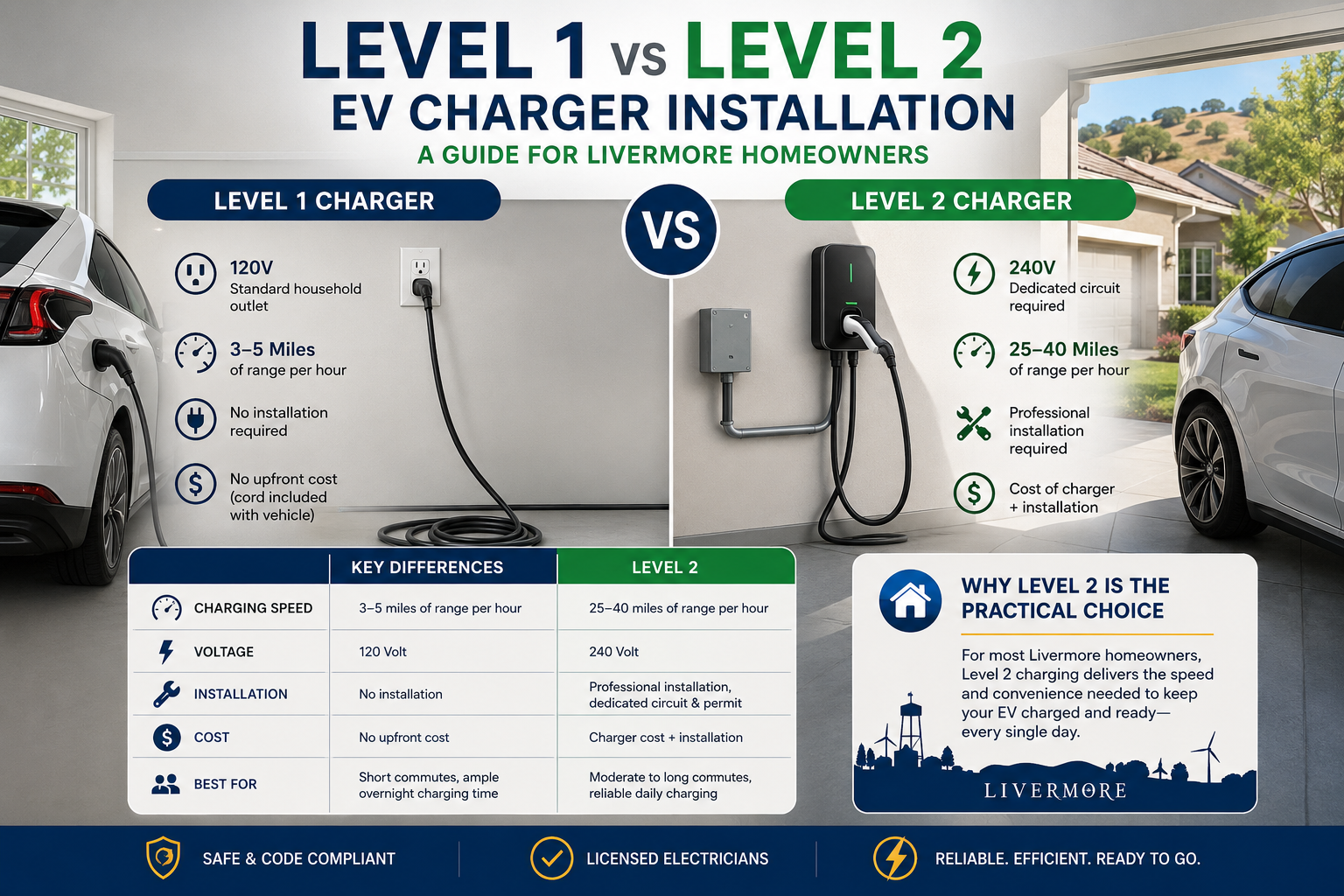
Level 1 vs Level 2 EV Charger Installation: A Guide for Livermore Homeowners
Buying an electric vehicle is an exciting step, but the experience only feels complete once you can charge reliably at home. For Livermore homeowners exploring their options, the choice between a Level 1 and a Level 2 charger is one of the first and most important decisions to make. Understanding the differences between the two will help you select the setup that matches your daily driving habits, your budget, and your home’s electrical capacity. A licensed electrician who provides professional EV charger installation services can walk you through each option and recommend the best fit for your situation.
This guide breaks down how Level 1 and Level 2 chargers work, what each one requires from your home’s electrical system, and how to determine which option will keep your vehicle charged and ready without putting unnecessary strain on your household circuits.
Understanding the Basics of EV Charging Levels
Before comparing the two options side by side, it helps to understand what the “level” designation actually means. EV charging levels refer to the amount of electrical power delivered to the vehicle’s battery. The higher the level, the faster the charge. Level 1 and Level 2 are the two types most commonly used in residential settings. Level 3, also known as DC fast charging, is typically reserved for commercial stations due to the extreme power requirements involved.
The right charger for your home depends on several factors, including how many miles you drive each day, how much downtime your vehicle has between trips, and whether your electrical panel can support the additional load.
How Level 1 Charging Works
Level 1 charging uses a standard 120 volt household outlet, the same type of outlet you would use for a lamp or a phone charger. Every electric vehicle sold in the United States comes with a Level 1 charging cord, so there is no additional hardware to purchase out of the box.
The limitation is speed. A Level 1 charger typically delivers between three and five miles of range per hour of charging. For a vehicle with a 250 mile battery, a full charge from empty can take upward of 40 to 60 hours. For drivers with short daily commutes of 30 miles or less, Level 1 charging can be adequate as long as the vehicle is plugged in overnight. For anyone who drives farther or needs to recharge quickly between trips, the slow pace becomes a significant constraint.
Level 1 charging does have the advantage of simplicity. There is no need for new wiring, no dedicated circuit, and no permit. You plug in and charge. That ease of setup makes it a reasonable starting point for new EV owners who want to try the basics before committing to a more permanent installation.
How Level 2 Charging Works
Level 2 charging operates on a 240 volt circuit, the same type used by electric dryers and ovens. This higher voltage allows the charger to deliver roughly 25 to 40 miles of range per hour, which means most vehicles can go from empty to full overnight in eight to ten hours. For the majority of Livermore homeowners, this is the level of charging that makes daily EV ownership feel effortless.
A Level 2 charger requires a dedicated circuit, a compatible outlet or hardwired connection, and a charging unit mounted in the garage or on the exterior of the home. Popular brands include Tesla, ChargePoint, and several others that work across all EV makes and models. The installation involves running a new circuit from the electrical panel to the charging location, which typically requires a permit and a final inspection to verify code compliance.
Key Differences Between Level 1 and Level 2
When you compare the two options directly, the differences become clear.
- Charging speed: Level 1 adds roughly 3 to 5 miles of range per hour. Level 2 adds 25 to 40 miles per hour of charging.
- Voltage: Level 1 runs on a standard 120 volt outlet. Level 2 requires a 240 volt dedicated circuit.
- Installation: Level 1 requires no installation at all. Level 2 requires professional electrical work, including a new circuit, a mounted charging unit, and a permit.
- Cost: Level 1 has no upfront cost beyond the cord included with the vehicle. Level 2 involves the cost of the charging unit plus installation, which varies depending on the distance between the panel and the charging location and whether the panel needs an upgrade.
- Best for: Level 1 suits drivers with very short commutes and ample overnight charging time. Level 2 suits drivers who need reliable daily charging for moderate to long commutes.
For most Livermore households with one or more electric vehicles, Level 2 is the practical choice for keeping up with everyday driving demands.
Electrical Requirements for a Level 2 EV Charger Installation
One of the most common questions homeowners ask is whether their current electrical setup can handle a Level 2 charger. The answer depends on the capacity of the existing panel and how many circuits are already in use.
A Level 2 charger typically draws between 30 and 50 amps. If the home’s panel is a 200 amp unit with available capacity, adding a dedicated circuit for the charger is usually straightforward. Homes with older 100 amp panels may not have enough room to support the additional draw, which means a panel upgrade could be necessary before the charger can be installed safely.
Golden Electrical Services performs a load calculation as part of every EV charger installation to determine whether the existing panel can accommodate the new circuit. This step ensures that the charger operates safely without overloading the home’s electrical system and helps homeowners avoid unexpected issues after the installation is complete.
In addition to the panel, the electrician will evaluate the wiring path from the panel to the garage or exterior wall where the charger will be mounted. Longer runs or routing through finished walls may add complexity, but a qualified electrician can plan the most efficient path while keeping the installation clean and up to code.
Choosing the Right Charger for Your Livermore Home
Selecting the right charger comes down to matching your daily needs with the capabilities of each level. Start by estimating how many miles you drive on a typical day. If your total commute is under 30 miles and you have a full overnight window for charging, Level 1 may work in the short term. If your daily mileage is higher, or if you share the vehicle with another driver, Level 2 will deliver the speed and reliability you need.
It is also worth considering future needs. If you plan to add a second electric vehicle, install solar panels, or make other upgrades that increase your home’s electrical demand, getting a Level 2 charger and addressing your panel capacity now can save you from having to revisit the electrical work later.
Livermore’s warm summers and active lifestyle mean many households are already drawing heavy electrical loads for air conditioning, pool equipment, and home offices. Adding an EV charger to that mix requires a thoughtful approach to capacity planning, which is exactly why a professional evaluation before installation matters so much.
Key Takeaways
- Level 1 charging uses a standard 120 volt outlet and adds roughly 3 to 5 miles of range per hour, making it suitable only for very short daily commutes.
- Level 2 charging uses a 240 volt dedicated circuit and delivers 25 to 40 miles of range per hour, covering the needs of most daily drivers.
- A Level 2 EV charger installation requires a dedicated circuit, a permit, and professional electrical work.
- A load calculation determines whether your existing panel can support the charger or whether an upgrade is needed first.
- Planning for future electrical needs, such as a second EV or solar panels, can help you avoid repeat work down the road.
Frequently Asked Questions
Can I use a regular outlet to charge my electric vehicle?
Yes. Every electric vehicle comes with a Level 1 charging cord that plugs into a standard 120 volt outlet. However, the charging speed is slow, typically adding only 3 to 5 miles of range per hour. For drivers with longer commutes or limited overnight charging time, a Level 2 charger is a more practical solution.
How long does a Level 2 EV charger installation take?
Most installations are completed within a few hours to a full day, depending on the distance between the electrical panel and the charging location. If a panel upgrade is needed, the project may require additional time.
Do I need a permit for EV charger installation in Livermore?
Yes. A Level 2 EV charger installation in Livermore requires an electrical permit, and the completed work must pass a final inspection to confirm it meets local and National Electrical Code standards.
Will a Level 2 charger work with any electric vehicle?
Most Level 2 chargers use a standard J1772 connector that is compatible with the majority of electric vehicles sold in the United States. Tesla vehicles use a proprietary connector but can also charge from a J1772 outlet with an adapter. Newer Tesla models include a NACS port that many other manufacturers are beginning to adopt as well.
How much does it cost to install a Level 2 EV charger?
The total cost depends on the price of the charging unit, the distance from the panel to the installation location, and whether any panel work is needed. Most homeowners can expect to invest anywhere from several hundred to a few thousand dollars for the full installation. Requesting a professional evaluation is the best way to get an accurate estimate for your home.
Can my electrical panel handle a Level 2 charger?
That depends on the panel’s amperage rating and how much capacity is already being used. A licensed electrician can perform a load calculation to determine whether your panel has room for a dedicated 30 to 50 amp circuit or whether an upgrade is required first.
Conclusion
Choosing between a Level 1 and a Level 2 EV charger is one of the most practical decisions you will make as an electric vehicle owner. For most Livermore homeowners, a Level 2 charger provides the speed and reliability needed to keep up with daily driving demands while adding lasting value to the home. The key is working with a licensed electrician who can evaluate your electrical system, recommend the right setup, and handle the EV charger installation from start to finish. If you are ready to explore your options, contact us today to schedule a professional evaluation and take the first step toward convenient, reliable home charging.