
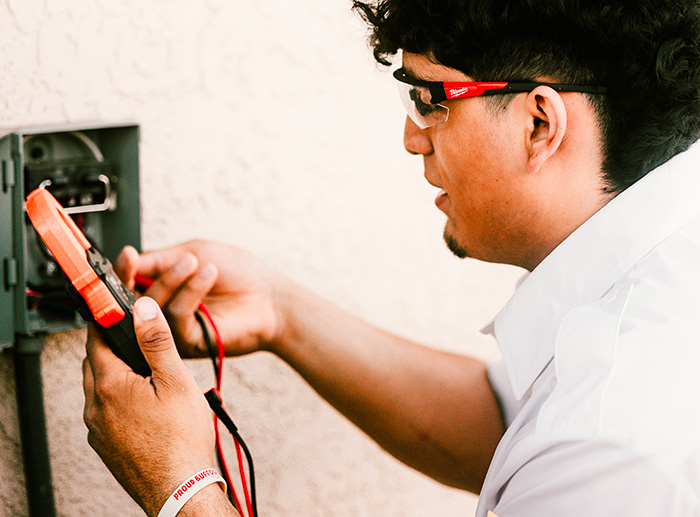
A breaker that trips is usually working correctly. That single point resolves most of the confusion around circuit breaker replacement, because homeowners tend to treat tripping as the failure when it is more often the protection doing its job against a circuit carrying more than it should. The real question is whether the breaker is reporting a problem or has become one, and answering it is the first step in any competent residential electrical diagnosis in a Livermore home.
SHORT ANSWER
Replace a breaker when it will not reset or hold, feels hot, shows scorching or discoloration, buzzes, sits loosely in the panel, or trips with no load on the circuit. Replace it also when it fails to trip during a genuine fault, which is the most dangerous version and the hardest to notice. A breaker that trips whenever several appliances run at once is not defective. That is an overload, and the correct fix is a dedicated circuit or added capacity, never a larger breaker.
The Distinction That Matters Most
Breakers protect wire. The size of the breaker is determined by the gauge of the conductor behind it, not by what a homeowner wants to plug in. A fifteen amp breaker on fourteen gauge wire trips at fifteen amps because that is the point beyond which the wire begins overheating inside the wall.
This is why installing a larger breaker to stop nuisance tripping is genuinely dangerous rather than merely improper. It removes the protection while leaving the undersized wire in place, and the failure that follows happens inside a wall cavity where nobody sees it developing. Any electrician who suggests upsizing a breaker without also upsizing the conductor should be declined.
So the diagnostic order runs: determine what the circuit is actually carrying, then determine whether the breaker is responding appropriately to that load.
Signs a Breaker Actually Needs Replacing
- It will not reset, or will not stay reset. After confirming the circuit is not faulted, a breaker that refuses to hold has failed internally.
- It trips with nothing connected. With the circuit unloaded, a tripping breaker is reporting on itself.
- It feels warm or hot. Breakers should be at ambient temperature. Heat indicates high resistance at the connection or internal degradation.
- Visible damage. Scorching, melting, pitting, or discoloration on the breaker body or at the bus contact.
- Buzzing or crackling. Sound from the panel suggests arcing, which does not improve on its own.
- It sits loosely. A breaker that does not seat firmly on the bus makes intermittent contact and generates heat at the connection.
- It does not trip when it should. A circuit that overheats appliances or cords without ever tripping means the protection is not functioning. This is the most serious sign and the one nobody notices until something else fails.
- Corrosion. Panels in garages and on exterior walls take moisture, and corroded contacts raise resistance.
Nuisance tripping on arc fault or ground fault breakers is its own category. Modern devices are sensitive by design, and repeated tripping may reflect a genuine wiring fault, an incompatible appliance, or a failing device. That one requires testing rather than assumption.
Age, Obsolescence, and Compatibility
Breakers must match the panel they go into. Manufacturers list specific breakers for specific panels, and installing a breaker that was not listed for the panel voids the listing, whether or not it physically fits. This matters more than it sounds, because bus geometry and contact pressure differ between makes.
Certain panels installed from the 1950s through the 1980s have documented histories of breakers failing to trip under fault conditions or of bus problems that damage breakers. Where one of those is found, replacing an individual breaker addresses a symptom while leaving the underlying equipment in place.
Availability is the practical constraint. When replacement breakers for a panel are no longer manufactured and only available used or reconditioned, the panel itself has effectively reached the end of its serviceable life. Installing a used breaker of unknown history into a safety device is a poor trade.
What to Expect During Circuit Breaker Replacement
- Diagnosis before parts. Confirming whether the breaker or the circuit is at fault, including measuring actual current on the circuit under real load rather than estimating it.
- Panel assessment. Identifying the panel make and model, checking bus condition, verifying that listed replacement breakers are available, and looking for heat damage.
- Safe shutdown. Power is turned off at the main, though the service conductors and main lugs remain energized. This is why the work is not a homeowner task even though the breaker itself snaps in.
- Replacement and torque. Terminations are tightened to the manufacturer’s specification. Under-torqued connections are a leading cause of heat at the panel, and over-torquing damages the lug.
- Testing under load. The circuit is energized and loaded to confirm the breaker holds and the connection stays cool.
- Directory update. The panel schedule is corrected, which sounds trivial until someone needs to kill a circuit quickly.
Most single breaker replacements are completed in one visit. The variable is whether diagnosis reveals a circuit problem behind the breaker, which changes the scope.
When the Panel Is the Real Answer
Several findings shift the conversation from a breaker to the panel.
No available slots. A panel already packed with tandem breakers squeezed into single spaces has no room for the circuit you need.
Bus damage. Heat damage or corrosion on the bus is not repairable, and a new breaker installed on a damaged bus fails the same way the last one did. Confirming that condition is part of any electrical service call that starts at the panel.
Repeated failures. Multiple breakers failing in the same panel points at the panel rather than at coincidence.
Insufficient capacity. A house adding an EV charger, air conditioning, and modern appliances to service sized decades ago is not experiencing breaker failure. It is experiencing demand the service was never designed for. Planning EV charger installation is where many Livermore homeowners discover this, since a charger is a substantial continuous load and the calculation is unforgiving.
Solar interconnection. Adding solar has its own requirement, since the panel’s busbar rating limits how much combined utility and solar current the equipment can accept. Plenty of otherwise adequate panels fail on that specific point, and it surfaces during design rather than during installation.
Livermore Conditions Worth Knowing
Two local factors affect breaker service here.
Summer heat is the first. Sustained high temperatures raise ambient temperature inside garages and exterior panels, and breakers are thermally sensitive by design. A circuit that runs comfortably in March may nuisance trip in August at the same load, and panels in direct afternoon sun run hotter still.
Housing age is the second. Livermore’s older neighborhoods include homes wired for a fraction of current demand, some with aluminum branch circuits from the late 1960s and early 1970s, where connection integrity at the breaker matters more than usual. Newer subdivisions have adequate service but were not built anticipating EV charging and full electrification.
Commercial buildings face the same physics with different consequences, since a failed breaker in a commercial electrical system can take down equipment, refrigeration, or an entire operation rather than one room.
What Not to Do
- Do not install a larger breaker to stop tripping.
- Do not repeatedly reset a breaker that keeps tripping without finding out why.
- Do not install a breaker not listed for your panel because it fits.
- Do not use reconditioned breakers of unknown history in a residential panel.
- Do not open a panel cover without the training and equipment for it, since the main lugs stay energized with the main off.
Key Takeaways
- A breaker that trips under genuine overload is working, not failing.
- Breaker size is set by conductor gauge, so upsizing a breaker without upsizing wire removes protection.
- Heat, scorching, buzzing, loose seating, and refusal to hold are the signs of actual breaker failure.
- A breaker that never trips despite an overheating circuit is the most dangerous failure mode.
- Breakers must be listed for the specific panel, and unavailable replacements signal an obsolete panel.
- Bus damage, no available slots, repeated failures, or insufficient capacity point to panel replacement.
- Livermore summer heat can cause nuisance tripping on circuits that behave normally in cooler months.
Frequently Asked Questions
My breaker trips every time I run the microwave and toaster together. Is it bad?
Almost certainly not. That is an overload on a shared circuit, and the breaker is protecting the wiring. The solution is a dedicated circuit for the higher draw appliance, not a different breaker.
Can I replace a breaker myself?
It is not advisable. The panel’s main lugs remain energized even with the main breaker off, terminations require specified torque, and the replacement must be listed for that panel. The risk is disproportionate to the cost of having it done.
How long do circuit breakers last?
Many operate for decades, though service life depends on load cycling, heat, moisture, and how many times the breaker has actually tripped. Age alone is less telling than condition and whether listed replacements remain available.
Is a warm breaker normal?
No. Breakers should be at roughly ambient temperature. Warmth indicates resistance at a connection or internal degradation, and it warrants inspection rather than monitoring.
Do I need a permit to replace a breaker?
Requirements vary by jurisdiction and scope. Straightforward like-for-like replacement is generally treated differently from panel replacement or service changes, which involve permitting and utility coordination. Confirm locally before work begins.
Why does my breaker only trip on hot days?
Breakers respond to heat, and high ambient temperature reduces the margin before tripping. A circuit near its limit in mild weather can exceed it during a Livermore summer, particularly if the panel is in an unconditioned garage or in direct sun.
Conclusion
Circuit breaker replacement is straightforward once the diagnosis is right, and the diagnosis is the part that gets skipped. Determining whether the breaker has failed or is reporting an overloaded circuit decides whether the correct answer is a new breaker, a new circuit, or more capacity. Skipping that step is how homes end up with a larger breaker protecting a wire that cannot carry it.
Golden Electrical Services diagnoses and replaces failing breakers, corrects overloaded circuits, and upgrades panels for homes and businesses in Livermore and across the Tri-Valley. If a breaker in your panel keeps tripping, feels warm, or will not hold, reach out today to schedule an assessment.